Research Through Design / Tangible Interaction / Physical Computing
Domesticated
How do machines teach us how to behave?
Three functioning wooden interfaces explore how machine response rules shape human action. Jana independently conceived, designed, fabricated, wired, and programmed all three objects in under ten weeks. Force, precision, and anticipation become physical questions about adaptation and perceived control.

Domesticated, 2026. The three functioning wooden interfaces with their independent designer and maker.
Year
2026
Institution
University of Washington · Undergraduate Thesis
Jana’s role
Independent designer, researcher, fabricator & programmer
Adviser / collaborators
Independent undergraduate thesis
Why this research
Interfaces do more than receive input: they define which actions count, how much effort is required, and when feedback arrives. Domesticated takes these conditions as its subject. Rather than designing a more efficient control, the project uses familiar physical forms to make the relationship between a person and a machine available for reflection.
Approach and scope
This independent undergraduate thesis uses research through design, combining iterative fabrication with physical computing. Three functioning wooden objects organize the inquiry around force, precision, and anticipation. Jana conceived, fabricated, wired, and programmed the work in under ten weeks. The artifacts and process photographs document a design inquiry; they do not constitute a participant study.
What this work contributes
The contribution is a set of three working artifacts that gives a broad question about machine influence a tangible form. Their shared material language supports comparison, while the switch, knob, and panel foreground different demands on action. The project connects conceptual framing to independent physical and computational execution.
Switch / Force
A familiar control becomes an inquiry into force: what does an interface ask of the body before it responds?
What must the body do to make the machine respond?

Switch study: hand interaction, exposed wiring, illuminated detail, and the finished object.

Knob study: turning gestures, surface details, and illumination in the original artifact photographs.
Knob / Precision
The knob explores precision as a condition of interaction. It sits between the familiarity of turning a control and the demands imposed by its response rules.
How precise is precise enough?
Panel / Anticipation
The panel turns attention toward anticipation and the relationship between action and feedback. Together, the three objects ask how machine rules invite adaptation.
Who sets the pace of an interaction?
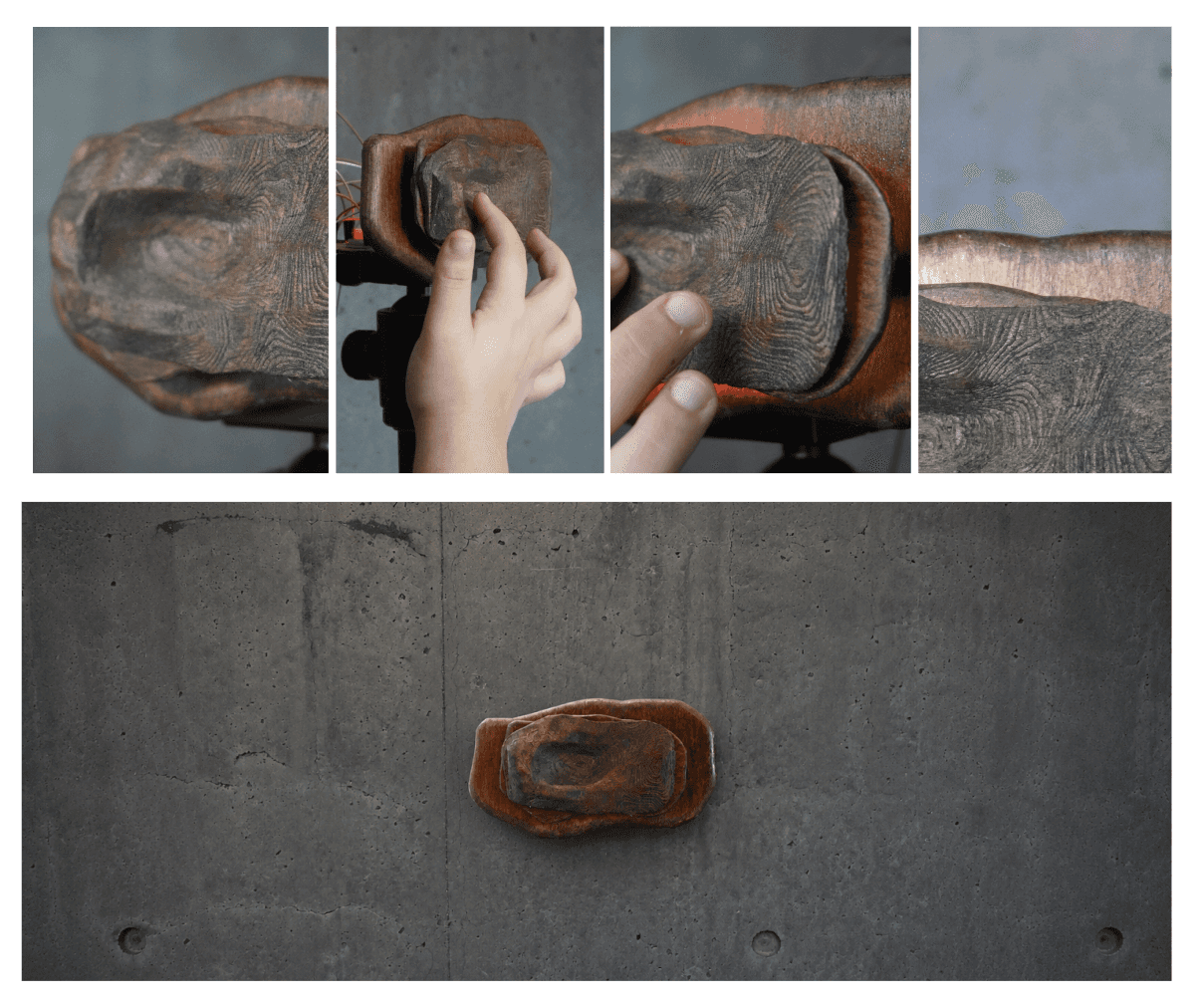
Panel study: touch, surface texture, and the finished object.
Making the behavior
Jana independently developed the physical objects, electronics, and programming. The original process record connects a handwritten wiring sketch to a breadboard test and printed parts, showing the work between the question and a functioning interface.

Original process record: a notebook wiring sketch, breadboard test, and printed parts. This is process documentation, not a verified final-system schematic.
Reading across the work
Across the three objects, agency can be considered through effort, accuracy, and timing rather than through an abstract claim of user control. This is an interpretive lens, not a measured result. A future study could ask people to describe how they discover response rules and distinguish what the object permits from what they choose.
Learning the rules, negotiating control
Domestication is a critical metaphor, not a demonstrated biological process. The next inquiry could examine how people learn the objects’ response rules and describe their sense of control. Prototyping observations and participant evidence should remain distinct; no empirical validation is claimed.
Documentation URL pending