Qualitative Design Research / Sociotechnical Systems
Healthcare at the Edges
How do community relationships and regional context shape experiences of healthcare?
A ten-week field study with 15 participants explored healthcare in rural communities through interviews, photo studies, storytelling, and mapping. Jana worked with Macks Brooks and Kaitlyn Ellington, advised by Audrey Desjardins, to investigate trust and informal care, synthesize accounts, and develop speculative design concepts.

Original mapping and research documentation from Healthcare at the Edges, 2025.
Year
2025
Institution
University of Washington, Interaction Design · Field Studies
Jana’s role
Collaborative design researcher
Adviser / collaborators
Macks Brooks, Kaitlyn Ellington · Adviser: Audrey Desjardins
Collaborative research. Jana’s specific responsibilities in recruitment, interviews, analysis, and concept development remain to be confirmed.
Why this research
Healthcare is encountered through relationships as well as through formal services. A focus on technological access alone can miss how trust, local knowledge, community support, and informal practices enter decisions about care. This study investigates those relationships within the rural settings represented by its participants.
Approach and scope
Over ten weeks, the team worked with 10 rural residents, 3 rural healthcare providers, and 2 experts through interviews, asynchronous photo studies, storytelling, and mapping. These methods offered different ways to describe experience. Participant accounts shifted the inquiry from technological realities toward cultural and community relationships. The sample is small and varied, not statistically representative.
What this work contributes
The collaborative work contributes a situated qualitative synthesis and speculative design responses. Four themes address reactive care and crisis; close-knit networks as sources of support and misinformation; community and nature in health practices; and reciprocal advocacy. Jana worked with Macks Brooks and Kaitlyn Ellington, advised by Audrey Desjardins; individual task ownership remains to be confirmed.
Listening across experiences of care
Interviews, asynchronous photo studies, storytelling, and mapping created different ways for participants to describe healthcare. The study included ten rural residents, three rural healthcare providers, and two experts.
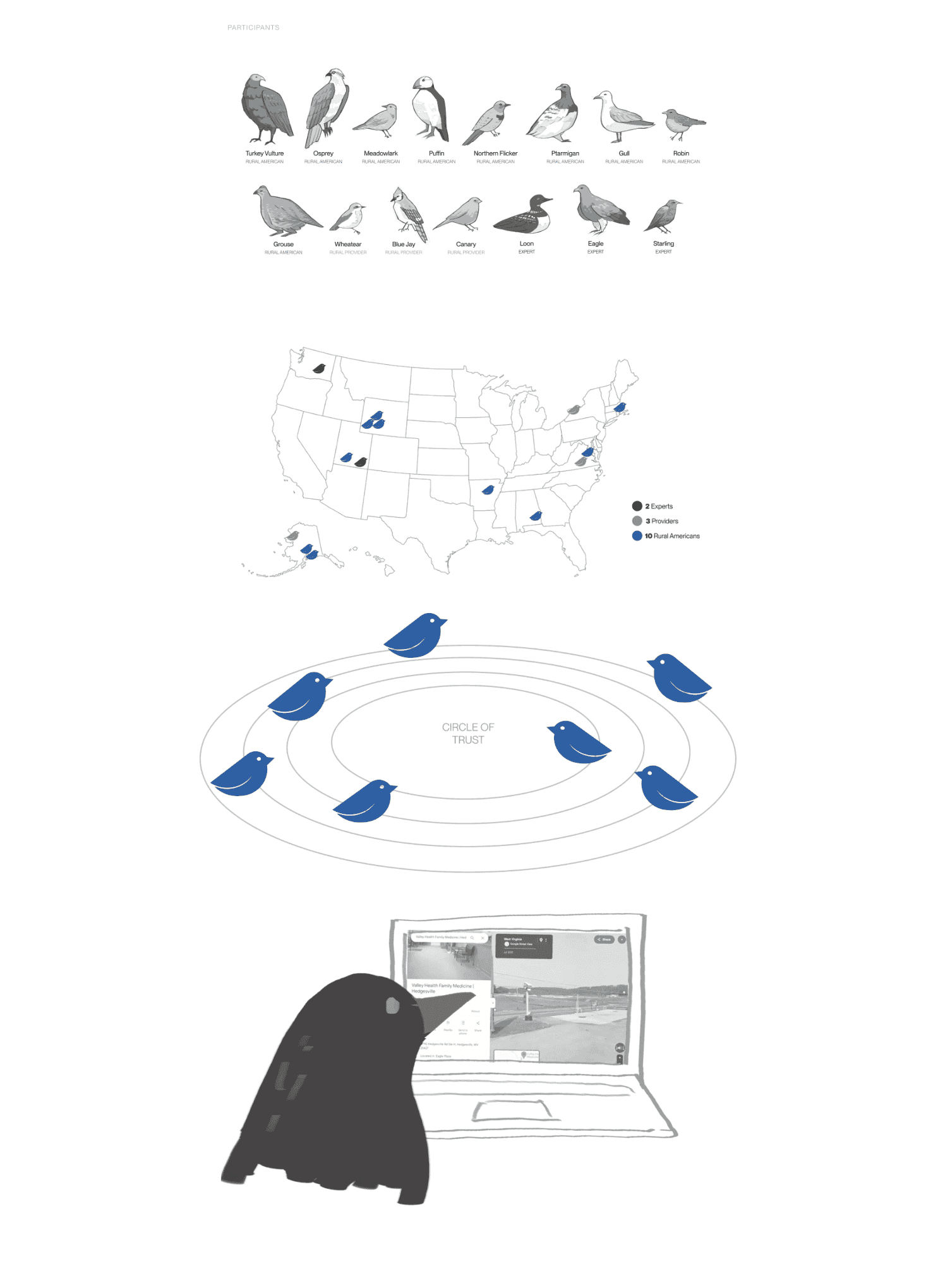
Original study documentation: participant pseudonyms, regional distribution, a circle-of-trust activity, and a remote-research illustration.
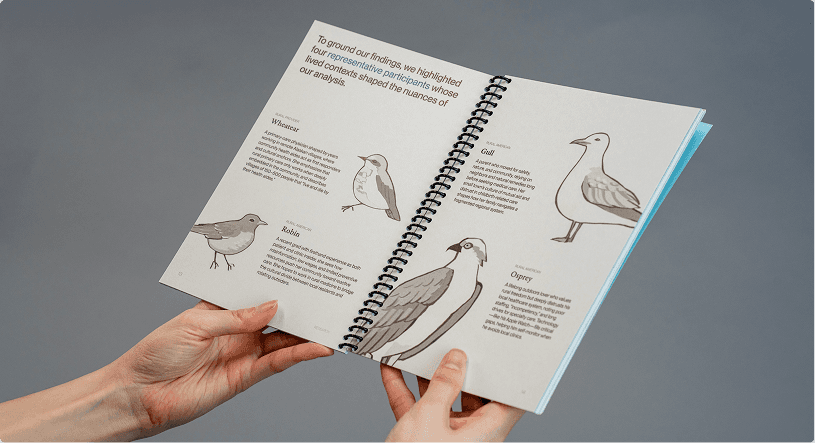
The original research report grounds its analysis in four participant accounts, represented through bird pseudonyms.
From technological realities to community relationships
Participant accounts shifted the team’s emphasis toward culture, trust, and the relationships through which care is practiced.
Care is not only a service. It is also a set of relationships.
Support and uncertainty coexist
The team developed four themes from participants’ accounts. Together, they describe care as both a response to crisis and a practice sustained through relationships.
Pending · Anonymized accounts + analytic connections
Reactive care and crisis
Close-knit networks: support and misinformation
Community and nature in health practices
Reciprocal advocacy
Town Health Herald
Misinformation concerns led the team to revise Town Health Herald to incorporate medical-professional perspectives.
Pending · Original concept
Pending · Revised concept
Pending · Concept revision + anonymized feedback
Care Calendar
Following participant feedback, the team revised Care Calendar to incorporate professional guidance.
Reading across the work
The synthesis complicates an uncomplicated story of community support: the same close-knit relationships can carry care and uncertainty. That tension informed revisions to Town Health Herald and Care Calendar, bringing medical-professional perspectives and guidance into the concepts. These are research-informed design decisions, not evidence of clinical effectiveness.
Care is situated
The study offers situated insight from a small, varied sample, not a general account of rural healthcare. The concepts are speculative design responses, not evidence of clinical effectiveness. Future work could examine community-centered care across additional settings with healthcare expertise.
Documentation URL pending